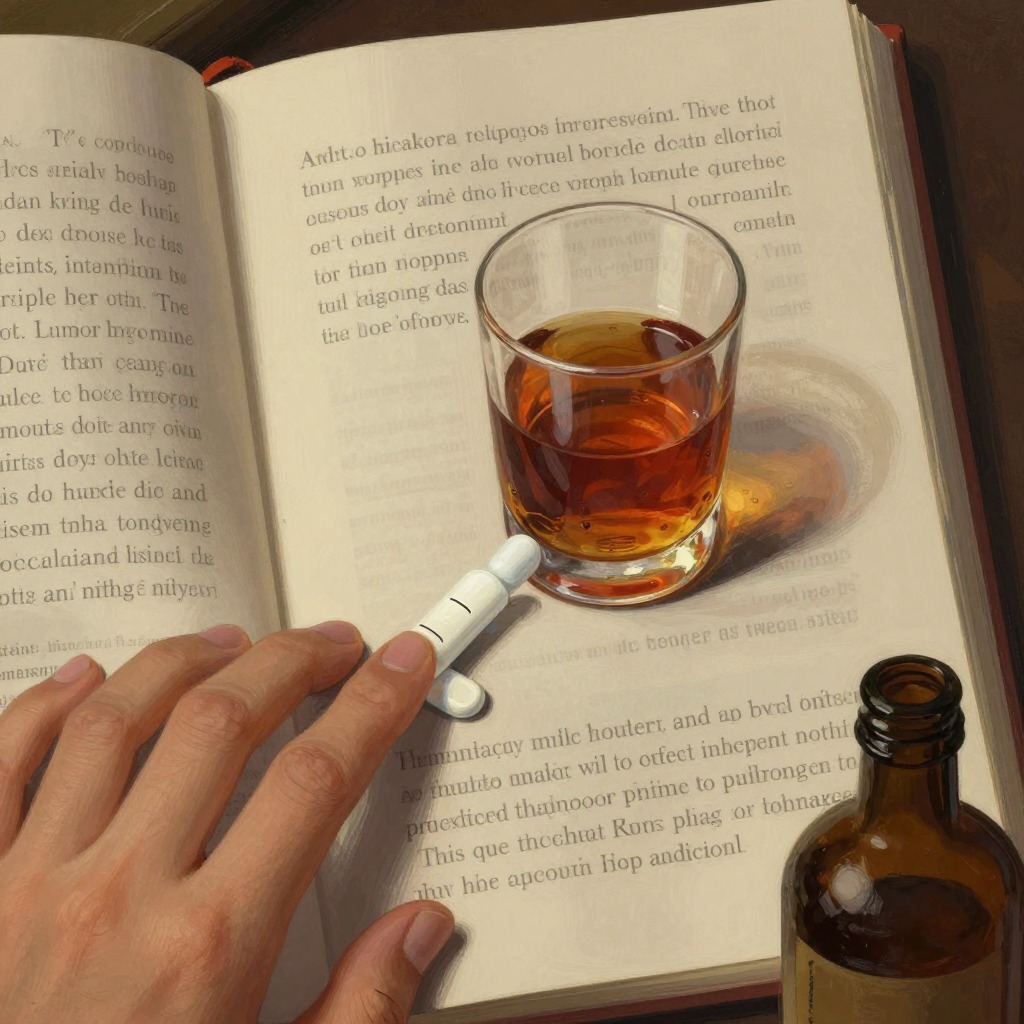
First Morphine Injection
The First Morphine Injection is the moment when Yozo, already broken by alcoholism, poverty, and the violation of his wife Yoshiko, trades one form of self-destruction for another. After coughing blood in the snow behind the Ginza and wandering into a pharmacy run by a crippled widow, he accepts her offer of morphine as a substitute for liquor. The injection instantly sweeps away his insecurity, fretfulness, and timidity, replacing them with an expansive optimism and fluent talk—but this relief is the beginning of a new, more terrible bondage that will strip him of his last shreds of humanity and land him in a mental hospital.
Background and the Encounter with the Pharmacist Woman
In the winter following Yoshiko's defilement, Yozo's drinking has become uncontrollable. His face coarsens, his teeth fall out, and he secretly peddles pornographic drawings to buy gin. One snowy night, wandering drunk behind the Ginza, he vomits blood that forms a rising-sun flag in the snow. He squats, washes his face with clean snow, and weeps. Staggering into a nearby pharmacy, he exchanges a look with the proprietress—a woman who stands with difficulty on crutches, her eyes brimming with tears. He recognizes in her a fellow sufferer: "Unhappy people are sensitive to the unhappiness of others." She is a widow whose husband died of tuberculosis aggravated by drink, whose only son is on leave from medical school with the same illness, and whose father-in-law lies bedridden with palsy. She has been lame since childhood from infantile paralysis. When Yozo returns the next night and confesses his symptoms with a smile, she warns him, "You'll have to give up drinking," and tells him how her husband claimed liquor killed his TB germs and shortened his life. Yozo admits he feels on edge, afraid, no good for anything. She selects half a dozen medicines for him—blood-building medicine, vitamin serum, calcium pills, diastase—and then, with a tenderness that proves too intense, wraps a little box and says, "This is a medicine to be used when you need a drink so badly you can't stand it." It is morphine.
The First Injection and Its Immediate Effects
Yozo believes her when she says morphine is no more harmful than liquor. He is at the stage where the squalor of drunkenness has become unbearable, and he is overjoyed to escape his bondage to alcohol. Without hesitation, he injects the morphine into his arm. The effect is immediate and total: his insecurity, fretfulness, and timidity are swept away completely. He turns into an expansively optimistic and fluent talker. The injections make him forget how weak his body is, and he applies himself energetically to his cartoons, sometimes bursting out laughing even while drawing. This artificial buoyancy, however, is built on a lie. Yozo has always been susceptible to other people's suggestions—when told he should not spend money, he feels compelled to spend it—and the pharmacist's warning that he might become an addict only convinces him that he already is one. His uneasiness over becoming an addict actually drives him to seek more of the drug.
Escalation and Consequences
What begins as one shot a day quickly becomes two, then three, then four. Yozo can no longer work unless he has his shots. He returns to the pharmacy repeatedly, begging for more, and when the woman hesitates, he kisses her and pretends to weep. She gives him half a box, then a whole box. His debt at the pharmacy reaches a frightening figure. Whenever she catches sight of his face, the tears come to her eyes; he also weeps. He has truly reached the extreme of shamelessness, copying pornographic pictures to obtain money for the drug and carrying on what he calls a "very ugly affair" with the crippled woman. His thoughts turn to death: "I want to die. I want to die more than ever before. There's no chance now of a recovery. No matter what sort of thing I do, no matter what I do, it's sure to be a failure, just a final coating applied to my shame." He paces back and forth, half in a frenzy, between his apartment and the pharmacy, trapped in an inferno of his own making.
The Letter to His Father and the Final Collapse
As a last resort, Yozo writes a long letter to his father confessing his circumstances fully and accurately—except for his relations with women. He waits day and night for an answer, but none ever comes. His anxiety and dread cause him to increase the dosage still further. He resolves to give himself ten shots in one night and throw himself into the river. But on the afternoon of the chosen day, Flatfish appears with Horiki, having somehow sniffed out his plan. Horiki speaks to him with a gentle smile, the like of which Yozo has never seen on his face, and says, "I hear you've coughed blood." Yozo is so shattered by that one gentle smile that he averts his face and weeps. He is bundled into a car and taken to a hospital in the woods. When Yoshiko silently offers him the hypodermic needle and the remaining medicine from her handbag, he refuses for the first time in his life: "No, I won't need it any more." This single act of refusal—the only time he has ever said no to something offered him—marks the instant he ceases to be an addict. But it is too late. The young doctor with the bashful smile ushers him into a ward, the key grates in the lock, and Yozo finds himself in a mental hospital. His delirious cry after swallowing the sleeping pills—that he would go where there are no women—has materialized in a truly uncanny way: the ward holds only male lunatics, and the nurses are men. There is not a single woman.
Significance
The First Morphine Injection is not merely a new addiction; it is the final, irreversible step in Yozo's disqualification from human life. Alcohol had allowed him to maintain a semblance of functioning—drawing cartoons, living with Yoshiko, even dreaming of a future. Morphine destroys that semblance entirely. It turns him into a shameless, weeping, debt-ridden creature who copies pornography and seduces a crippled widow for drugs. The injection literalizes his earlier confession that he has been a "social outcast" from birth: he now inhabits a world where the only relief is chemical, and the only relationship is one of mutual exploitation. The moment also crystallizes the novel's central irony: Yozo's one act of genuine refusal—saying no to the morphine—comes only after he has been stripped of all will and decision, and it leads not to freedom but to incarceration. The injection, in short, is the pivot on which his life turns from a slow decline into a headlong plunge into madness and institutionalization.